

+918048128529

Currently it only shows your basic business info. Start adding relevant business details such as description, images and products or services to gain your customers attention by using Boost 360 android app / iOS App / web portal.

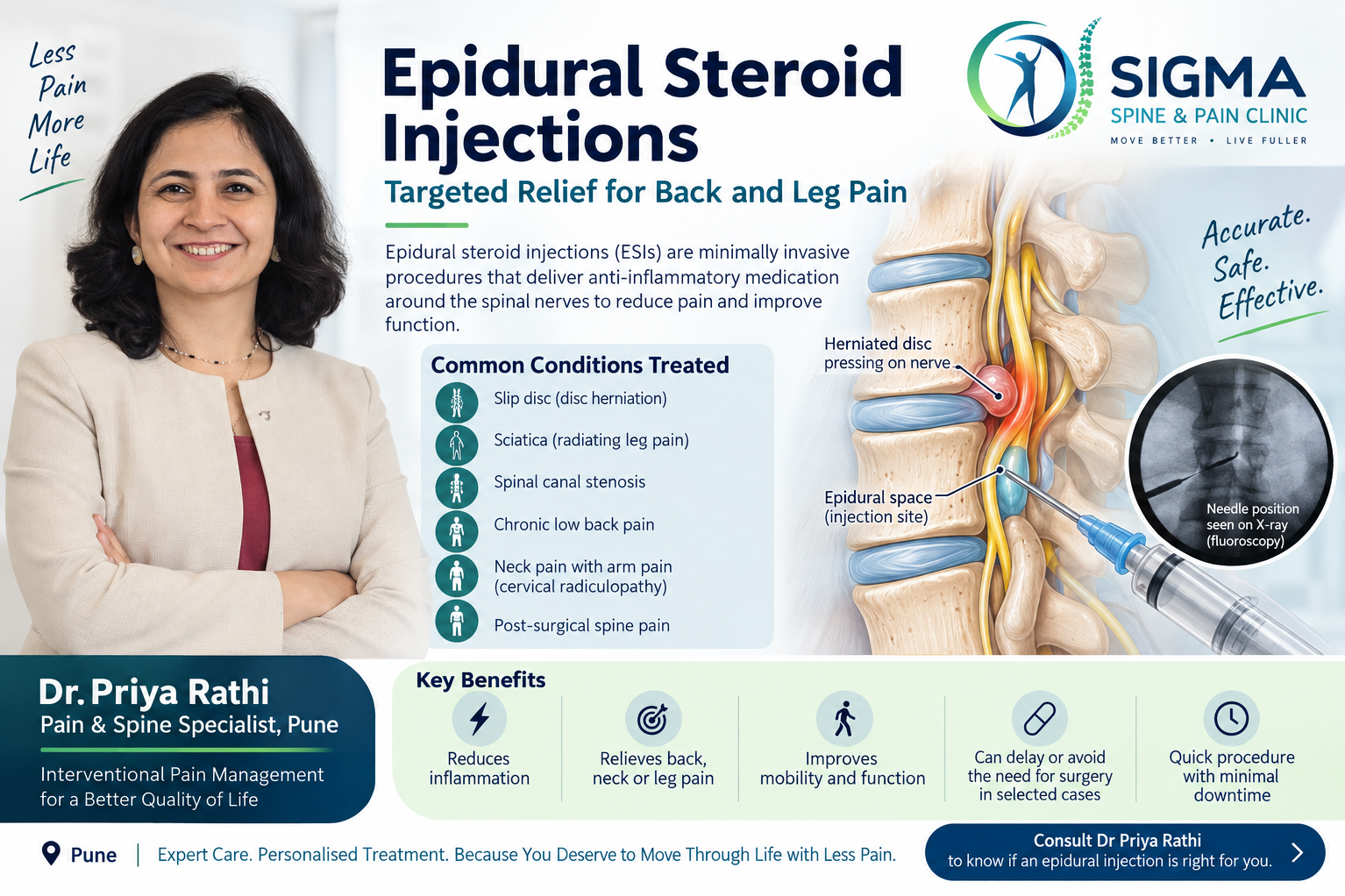
Back pain is extremely common, but not every type of back pain needs the same treatment. Some people have pain that stays in the lower back. Others have pain that travels from the back into the buttock, thigh, calf or foot. You may also experience burning, tingling, numbness or an electric-shock-like sensation in the leg. When a spinal nerve is irritated or inflamed, this type of pain is often called sciatica or radicular pain. For selected patients, an epidural steroid injection can be an option for reducing inflammation around an irritated spinal nerve and providing pain relief. I am Dr Priya Rathi, Pain and Spine Specialist in Pune, and I use image-guided interventional pain procedures as part of a personalised approach to treating spine and nerve-related pain. What is an epidural steroid injection? An epidural steroid injection, commonly called an ESI, is a minimally invasive procedure in which medication is delivered into the epidural space around the spinal nerves. The steroid is an anti-inflammatory medicine. When a nerve root is irritated by conditions such as a slipped disc or narrowing around the nerve, inflammation can contribute significantly to pain. The purpose of an epidural injection is not simply to 'put a painkiller into the back.' The aim is to deliver medication close to the irritated nerve and reduce inflammation so that the patient can move more comfortably and return to normal activities. Depending on the location and cause of pain, an epidural injection may be performed in the cervical, thoracic or lumbar region of the spine. When is an epidural steroid injection considered? An epidural injection is not necessary for everyone with back pain. It is generally considered when symptoms suggest irritation of a spinal nerve and when appropriate conservative treatment has not provided adequate relief. Some common situations where an epidural steroid injection may be considered include: * Sciatica or radiating leg pain * Lumbar radiculopathy * Cervical radiculopathy causing neck and arm pain * Pain associated with a slipped disc or disc herniation * Spinal canal or foraminal narrowing with nerve irritation * Selected cases of persistent back or neck pain associated with inflammation around spinal nerves * Certain cases of persistent pain after spine surgery The exact procedure depends on your symptoms, examination findings and imaging. This is important because an MRI may show several abnormalities, but not every abnormality is necessarily responsible for your pain. Does every slipped disc require an epidural injection? No. This is one of the most common misconceptions I hear from patients. A slipped disc on an MRI does not automatically mean that an injection—or surgery—is required. Some disc problems cause little or no symptoms. In other patients, the disc may irritate a nerve and cause significant leg or arm pain. Treatment should therefore be based on the **patient's symptoms, clinical examination and imaging findings together**, rather than the MRI report alone. For some patients, medication, activity modification and rehabilitation may be enough. For others with persistent nerve-related pain, an epidural injection may be discussed as one part of treatment. How does an epidural steroid injection work? Think of an irritated spinal nerve as a nerve that has become inflamed and sensitive. The steroid medication is intended to reduce this inflammation around the nerve. The injection does not 'push the disc back into place.' It does not permanently remove a slipped disc. Instead, it is used to control inflammation and pain associated with nerve irritation. When pain decreases, some patients are able to walk better, sleep better and participate more comfortably in their rehabilitation. That can be an important part of recovery. How is an epidural injection performed? The procedure is usually performed as a day-care procedure. The patient is positioned appropriately and the skin is cleaned using sterile precautions. Local anaesthesia is used to numb the skin. For procedures such as a **transforaminal epidural injection**, X-ray/fluoroscopy guidance is used to accurately identify the relevant spinal level and guide the needle. Contrast dye may be used to confirm the appropriate spread before medication is administered. The exact technique depends on the location and cause of the pain. The procedure itself is generally relatively short, although the preparation and observation period take additional time. Most patients can go home after a period of observation. Is an epidural steroid injection painful? Patients are often nervous about this. The skin is numbed before the procedure, so there may be a brief sting from the local anaesthetic. You may feel pressure during the procedure. If the irritated nerve is already very sensitive, you may occasionally feel a temporary reproduction of your familiar pain or a sensation travelling into the leg or arm. Patients are monitored throughout the procedure. How quickly does an epidural injection work? The response varies from person to person. Some patients notice improvement relatively soon, while for others the anti-inflammatory effect develops over several days. The amount and duration of relief also depend on the underlying condition. An epidural injection should therefore not be thought of as a guaranteed 'permanent cure.' For the right patient, however, it can provide a useful window of pain relief during which normal movement and rehabilitation become easier. How long does the pain relief last? There is no single answer. Some patients experience relief for weeks or months, while others may have limited benefit. The duration depends on factors such as the cause of the pain, severity of nerve irritation, duration of symptoms and the patient's overall condition. Research suggests that epidural steroid injections can provide short-term improvement for some patients with radicular pain, while longer-term benefit is less predictable. This is why I believe that an injection should be recommended only when there is a reasonable clinical indication—not simply because a patient wants an injection. Can an epidural injection prevent surgery? An epidural injection is not a replacement for surgery when surgery is clearly indicated. However, in selected patients, reducing nerve inflammation and controlling pain may help them improve without immediately proceeding to surgery. The decision depends on the cause and severity of symptoms. If there is significant or progressive weakness, severe neurological compromise, or another condition requiring urgent surgical treatment, an injection may not be appropriate. Are epidural steroid injections safe? When performed by an appropriately trained specialist using proper technique and appropriate imaging guidance, epidural injections are generally considered safe procedures. However, no medical procedure is completely risk-free. Possible complications include temporary increase in pain, headache, bleeding, infection, allergic reaction, temporary numbness or weakness and other procedure-specific complications. Rare but serious neurological complications have also been reported with epidural corticosteroid injections. The FDA has specifically warned about rare serious events including spinal cord infarction, paralysis, stroke and loss of vision. This is exactly why the procedure should not be treated like a routine 'back injection.' Patient selection, appropriate imaging guidance, sterile technique, medication selection and knowledge of spinal anatomy are extremely important. What should you tell your pain specialist before the procedure? Before an epidural injection, tell your doctor about: * Blood-thinning medicines * Bleeding disorders * Diabetes * Current infections or fever * Medication allergies * Previous reactions to injections * Pregnancy or possibility of pregnancy * Previous spine surgery * Any new or progressive weakness or numbness Your doctor will decide whether the procedure is appropriate and whether any medication needs to be adjusted before the injection. ## What happens after the injection? Most patients are observed for a short period after the procedure. You may experience some soreness at the injection site. Depending on the procedure and medication used, temporary changes in pain or sensation can occur. Your doctor will give you specific instructions regarding activity, medicines and follow-up. If you develop unusual or severe symptoms after an epidural injection—such as significant weakness, new loss of sensation, severe headache, vision changes, seizures or other concerning neurological symptoms—urgent medical assessment is required. ## Epidural injection vs. ordinary pain injection Many patients use the words 'injection for back pain' very broadly. An epidural steroid injection is different from an injection into a muscle or a joint. The **epidural space is around the spinal nerves**, and the purpose of the procedure is to address inflammation associated with nerve-related pain. Similarly, a facet joint injection, sacroiliac joint injection, trigger point injection and epidural injection are different procedures used for different pain generators. This is why identifying the actual source of pain is so important before deciding on an intervention. ## What I tell my patients about epidural injections An injection should never be the first answer to every backache. Before recommending an epidural steroid injection, I look at the patient's history, symptoms, examination and relevant imaging to understand whether the pain is actually coming from an irritated spinal nerve. Sometimes the most appropriate treatment is an epidural injection. Sometimes it is a different interventional procedure. And sometimes the patient does not need an injection at all. The goal is not simply to perform a procedure. The goal is to identify the pain generator and choose the treatment that makes sense for that particular patient. ## Looking for an epidural steroid injection in Pune? If you have persistent **back pain, sciatica, leg pain, neck pain, arm pain, slipped disc-related pain or nerve pain**, a consultation with a pain specialist can help determine whether an epidural injection is appropriate for you. I am **Dr Priya Rathi, Pain and Spine Specialist in Pune**, specialising in interventional pain management and minimally invasive procedures for spine and musculoskeletal pain. If your pain is affecting your walking, sleep, work or daily activities, don't simply keep taking painkillers and hoping it will settle. A proper assessment can help determine **where the pain is coming from and what treatment options are available**. **Dr Priya Rathi** Pain & Spine Specialist, Pune Interventional Pain Management Epidural Steroid Injections | Radiofrequency Procedures | Myofascial Pain Treatment | Chronic Pain Management This article is intended for general patient education and does not replace an individual medical consultation. Epidural steroid injections are not suitable for every patient, and the decision to perform the procedure should be made after appropriate clinical assessment.


