

+918048128529

Currently it only shows your basic business info. Start adding relevant business details such as description, images and products or services to gain your customers attention by using Boost 360 android app / iOS App / web portal.

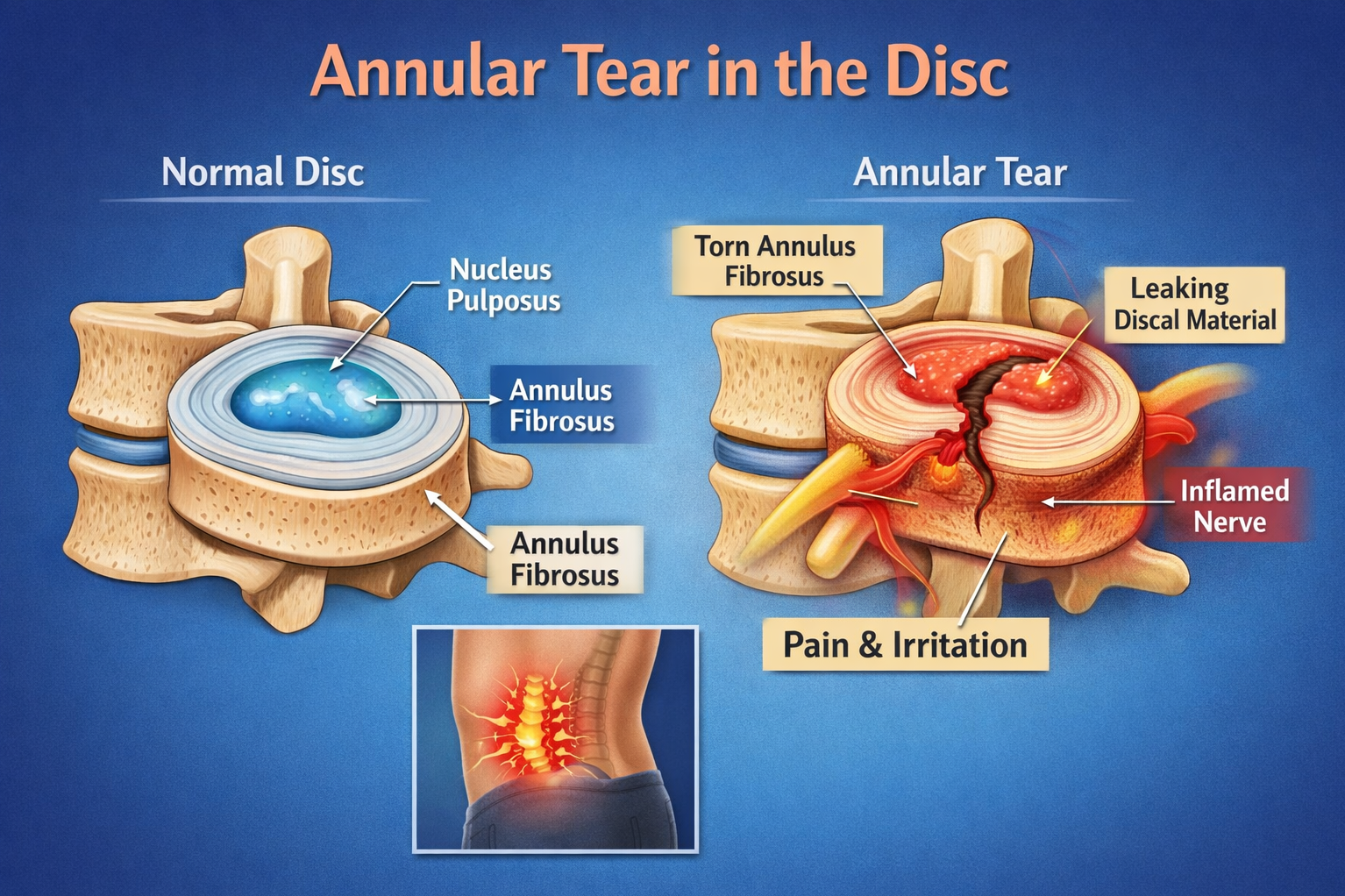
Is an Annular Tear in the Disc a Serious Condition? What is an annular tear? Your spine has soft cushions between the bones (vertebrae) called intervertebral discs. Each disc has: • a soft center (nucleus pulposus) • a tough outer ring (annulus fibrosus) An annular tear means a small crack or tear in this outer ring. It is not the same as a disc prolapse or slipped disc, though it can sometimes be associated with it. Is an annular tear serious? Not always. An annular tear sounds alarming, but in most people it is manageable and not dangerous. • Many annular tears heal on their own • Some people have annular tears without any symptoms • It becomes a concern mainly when it causes persistent pain It is usually a pain-related problem, not a life-threatening one. Why does an annular tear cause pain? The outer part of the disc has pain-sensitive nerve fibers. When a tear occurs: • Inflammatory chemicals can irritate nerves • Pain may be felt in the lower back or neck • Pain can worsen with sitting, bending, coughing, or prolonged posture Unlike sciatica, annular tear pain is often localized and deep, sometimes described as burning or aching. Common causes of annular tear • Age-related disc degeneration • Repeated bending or lifting • Poor posture and prolonged sitting • Sudden twisting injury • Long-standing back strain Symptoms you may notice • Persistent low back or neck pain • Pain worse on sitting or forward bending • Stiffness in the spine • Occasional referred pain (but usually no severe leg weakness) Red flag symptoms like loss of bladder control or severe weakness are rare with isolated annular tears. How is annular tear diagnosed? • MRI scan is the best test • Often reported as: o “Annular fissure” o “High-intensity zone (HIZ)” • Clinical symptoms are more important than MRI findings Many people have annular tears on MRI but no pain at all. Treatment of annular tear (non-surgical) Most patients improve with conservative treatment: • Activity modification (not complete bed rest) • Pain medications (short-term) • Physiotherapy and core strengthening • Posture correction and ergonomic advice • Pain management procedures like epidural injections, platelet rich plasma therapy in disc, ultrasound guided dry needling if pain is persistent 🔹 Surgery is rarely required for annular tear alone. Can annular tear heal? Yes. The disc heals slowly because blood supply is limited, but: • Pain usually reduces over weeks to months • Proper guidance prevents progression to disc prolapse When should you see a pain specialist or spine specialist? • Pain lasting more than 6–8 weeks • Pain affecting daily activities or sleep • Recurrent episodes of back pain • MRI showing annular tear with persistent symptoms Early expert care can prevent chronic pain. Key take-home message ✔ Annular tear is common and often not serious ✔ MRI report alone should not cause panic ✔ Most cases are treated without surgery ✔ Correct diagnosis and pain-focused treatment matter


