

+918048128529

Currently it only shows your basic business info. Start adding relevant business details such as description, images and products or services to gain your customers attention by using Boost 360 android app / iOS App / web portal.

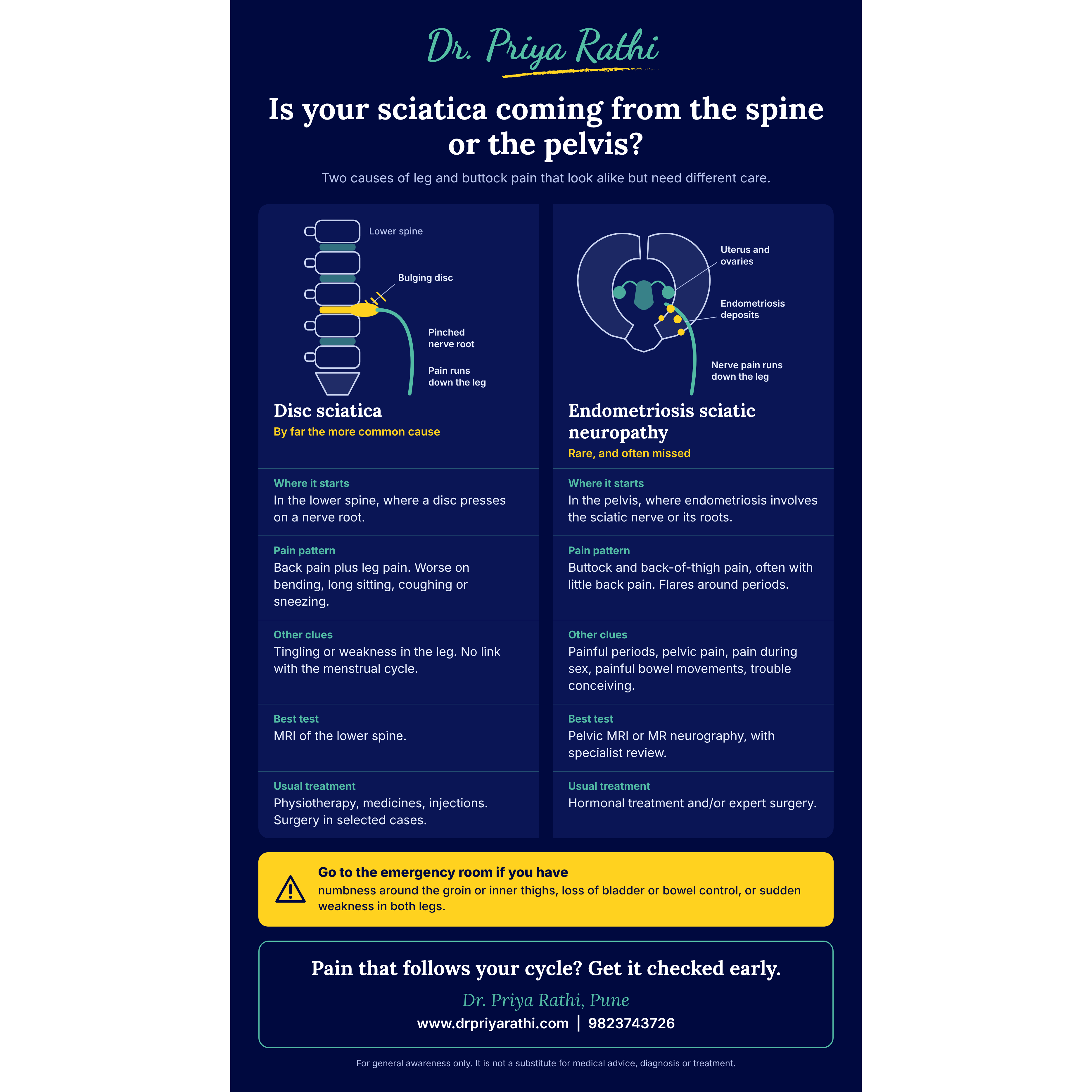
Sciatic Pain: Is It Your Disc, or Could It Be Endometriosis? An awareness article for women with leg and buttock pain that just won't go away If you are a woman with a burning, shooting or electric pain running from your buttock down the back of your leg, chances are you have been told it is 'sciatica from a slipped disc.' For most people, that is correct. But for a small group of women, the real cause is not in the spine at all. It is endometriosis affecting the sciatic nerve or the nerves in the pelvis. When this is missed, women can spend months or years on back treatments that never quite work. This article explains the difference in simple terms, so you know what to look out for and when to ask for a second look. First, what is the sciatic nerve? The sciatic nerve is the thickest nerve in the body. It is formed by nerve roots that leave the lower spine, pass through the pelvis, and then travel through the buttock and down the back of the leg to the foot. Anything that irritates or compresses this nerve along its long path can cause sciatic pain. The two causes we are comparing here sit at different points on that path: one at the spine, the other in the pelvis. Sciatica from a disc problem Between the bones of your spine are soft cushions called discs. If a disc bulges or slips out of place, it can press on a nearby nerve root. This is called lumbar radiculopathy, and it is by far the commonest cause of sciatica. What it usually feels like • Lower back pain along with pain travelling down one leg • Pain that worsens with bending forward, prolonged sitting, coughing or sneezing • Tingling, numbness or weakness in the leg or foot • Pain that follows no relationship to your menstrual cycle What usually happens next Most disc-related sciatica improves over weeks to a few months with rest from aggravating activity, physiotherapy, medication and gradual return to movement. An MRI of the lumbar spine usually shows the problem. Sciatic neuropathy from endometriosis Endometriosis is a condition in which tissue similar to the lining of the uterus grows outside it. Most often it affects the ovaries, pelvic lining and bowel. Rarely, it grows on or near the sciatic nerve or the nerve bundles of the pelvis (the sacral plexus). This can irritate, scar or compress the nerve, a condition called sciatic neuropathy. Clues that point towards endometriosis • Pain that follows your cycle. It may begin or worsen a few days before your period, peak during bleeding, and ease afterwards. Some women notice this only after keeping a diary. • Pain in the buttock and back of the thigh or leg without much back pain • Painful periods, long-standing pelvic pain, pain during intercourse, or painful bowel movements or urination around periods • Difficulty conceiving • Numbness, burning, weakness of the foot, or in some cases a dragging foot • Little or no improvement despite proper treatment for a disc problem, or a spine MRI that looks normal or does not explain the symptoms Because this form of endometriosis is uncommon and sits deep in the pelvis, it is easily missed. It is not seen on a spine MRI. It generally needs a specialist assessment, pelvic MRI or MR neurography, and sometimes laparoscopy. Note: the two can exist together. A woman may have a mild disc bulge on MRI and endometriosis, which is why the full picture matters. When to see a doctor Book a consultation if: • Sciatic-type pain keeps returning around your periods • Back treatment has not helped as expected • You also have painful periods, pelvic pain or fertility concerns • You notice numbness or weakness in the leg or foot Go to an emergency department immediately if you have numbness around the groin or inner thighs, loss of control over urine or stools, difficulty passing urine, or sudden weakness in both legs. These can signal a serious spinal emergency. What you can do now 1. Keep a symptom diary for 2 to 3 months, noting pain levels, location and your period dates. 2. Carry your old reports, including MRIs, to your appointment. 3. Do not accept 'it is just a disc' if the story doesn't fit. Ask whether a gynaecological cause has been considered. 4. Seek early evaluation. Nerve involvement treated early tends to recover better than nerve damage left for years. Book a consultation Dr Priya Rathi, Pune Website and appointments: www.drpriyarathi.com Phone: 9823743726 This article is for general awareness and is not a substitute for medical advice, diagnosis or treatment. Please consult a qualified doctor about your symptoms.


