

+918048128529

Currently it only shows your basic business info. Start adding relevant business details such as description, images and products or services to gain your customers attention by using Boost 360 android app / iOS App / web portal.

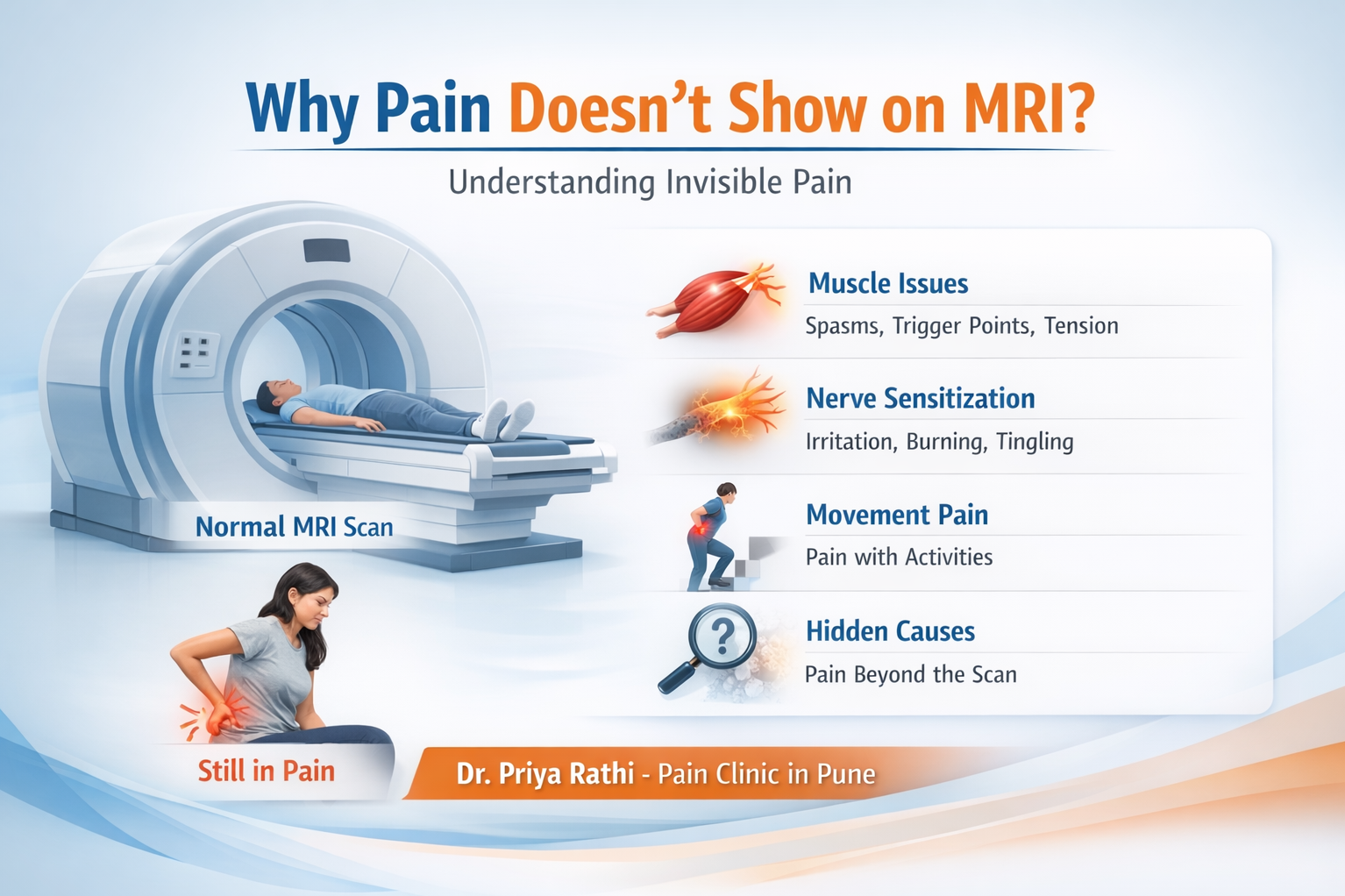
A simple explanation for patients Many people visiting a pain clinic in Pune say the same thing. My MRI is normal but my pain is severe and affecting my daily life. This situation is far more common than most people realise. Pain is an experience felt by the nervous system. MRI is only a picture of body structure. Pain and structure are not always directly linked. Below are common doubts patients have, explained in simple language. If MRI is normal, does it mean pain is not real Pain is always real. A normal MRI does not mean pain is imaginary, psychological, or exaggerated. MRI cannot capture everything that causes pain in the human body. What MRI is actually good at showing MRI is excellent for detecting problems like disc herniation, fractures, tumors, infections, and severe nerve compression. It gives a static image of bones, discs, and major nerves. What MRI does not show well are functional problems. These include muscle tightness, spasms, trigger points, early nerve irritation, posture-related pain, and pain related to movement or overuse. Why muscle-related pain does not appear on MRI Muscles are living, dynamic tissues. They contract, relax, fatigue, and sometimes get stuck in painful patterns. These changes do not damage the muscle structure, so MRI looks normal. Yet muscles can cause deep, constant pain, stiffness, heaviness, or even pain radiating to other areas. This is one of the most common reasons people suffer for years despite normal reports. How nerves can cause pain even with a normal MRI Nerves do not need to be compressed to cause pain. They can become inflamed, irritated, or overly sensitive. MRI mainly detects pressure on nerves, not chemical irritation or sensitivity. This explains burning pain, tingling, electric shock–like pain, or pain that changes with posture even when scans look normal. Why pain increases during daily activities MRI is done while lying still. Real-life pain happens during sitting, standing, walking, climbing stairs, bending, or turning in bed. Pain generators often reveal themselves only during movement and functional activities, which no scan can fully capture. Why pain can persist even after surgery or treatment Sometimes the original structural problem is corrected, but the pain pathways remain active. This is known as persistent pain or pain sensitization. In such cases, MRI may look perfectly fine, yet pain continues because the nervous system has learned the pain response. How pain is diagnosed when MRI is normal In a comprehensive pain clinic in Pune, diagnosis goes beyond reports. It includes listening to the pain story, understanding daily activity limitations, examining movement patterns, assessing muscles and nerves, and sometimes using ultrasound to evaluate soft tissues. Diagnosis is based on how pain behaves, not just how images look. How pain is treated when MRI is normal Treatment is directed at the real pain generator. This may include ultrasound-guided dry needling, targeted nerve blocks, trigger point injections, and other non-surgical pain interventions. The goal is pain relief, improved movement, and better quality of life, not just a normal report. When to consult a pain specialist If pain continues despite normal MRI, affects sleep or daily activity, or if you are repeatedly told nothing is wrong while pain persists, it is time to consult a pain specialist. Many such patients consult Dr Priya Rathi at a dedicated pain clinic in Pune for evaluation and non-surgical pain management. Final message Pain does not always live on MRI. A normal scan does not mean there is no problem. Pain needs understanding, not dismissal. With the right approach, relief is often possible even when investigations are normal.


